News Center
What Are the Differences Between Different Contact Angles in Angular Contact Ball Bearings?
2026-11-06
What Are the Differences Between Different Contact Angles in Angular Contact Ball Bearings?
Angular contact ball bearings are widely used in precision machinery, CNC machine tools, industrial equipment, and high-speed transmission systems. Unlike deep groove ball bearings, angular contact ball bearings are designed to support both radial and axial loads, making them suitable for applications requiring high precision, rigidity, and reliable performance.
When selecting angular contact ball bearings, several factors need to be considered, including bearing dimensions, precision class, cage material, and lubrication. One particularly important parameter is the contact angle.
Common contact angles include 15°, 25°, 30°, and 40°. Different contact angles affect the bearing's axial load capacity, radial load capacity, and high-speed performance.
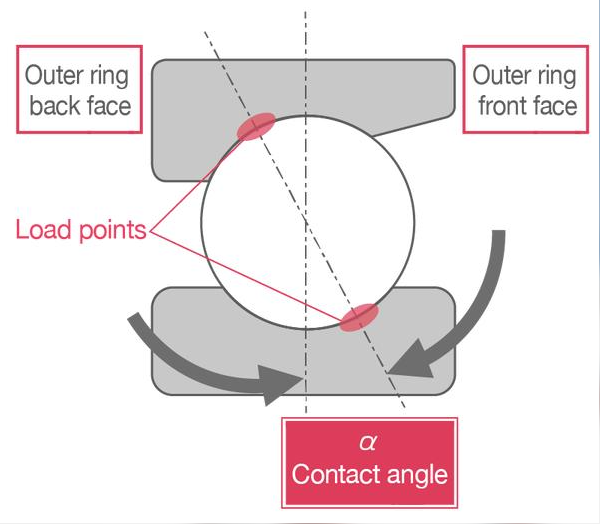
1. What Is the Contact Angle?
The contact angle is the angle formed between the line connecting the contact points of the rolling element and raceways and the radial plane of the bearing under load.
In simple terms, the contact angle determines how loads are transmitted through the bearing and influences its ability to support radial and axial forces.
Generally:
- A smaller contact angle is more suitable for high-speed applications.
- A larger contact angle provides greater axial load-carrying capacity.
- The appropriate contact angle depends on the actual operating conditions and application requirements.
2. Performance Characteristics of Different Contact Angles
15° Contact Angle – Designed for High-Speed Applications
Angular contact ball bearings with a 15° contact angle are commonly used in high-speed, high-precision applications.
Key features:
- Excellent high-speed performance.
- Suitable for applications requiring high rotational accuracy.
- Can support a certain level of axial load.
Typical applications:
CNC machine tool spindles, high-speed electric spindles, precision grinding machines, and other high-speed machinery.
25° Contact Angle – A Balance Between Speed and Load Capacity
A 25° contact angle offers a good balance between rotational speed and axial load-carrying capacity.
Key features:
- Good overall load-carrying performance.
- Higher axial load capacity than bearings with smaller contact angles, generally.
- Suitable for applications requiring both speed and axial rigidity.
Typical applications:
Precision machine tools, industrial spindles, pumps, and precision transmission systems.
30° Contact Angle – Focused on Overall Load Performance
Angular contact ball bearings with a 30° contact angle provide good axial load capacity while maintaining radial load-carrying capability.
Key features:
- Good axial load-carrying capacity.
- Suitable for applications involving relatively high axial loads.
- Can provide reliable support in mechanical systems requiring rigidity.
Typical applications:
Industrial machinery, machine tool transmission systems, and precision equipment.
40° Contact Angle – Suitable for Higher Axial Loads
A 40° contact angle is generally designed for applications where greater axial load-carrying capacity is required.
Key features:
- High axial load-carrying capacity.
- Suitable for applications subject to relatively large axial forces.
- Generally less suitable for extremely high-speed applications compared with smaller contact angles.
Typical applications:
Industrial transmission equipment, gearboxes, pumps, and machinery requiring higher axial load capacity.
3. Comparison of Different Contact Angles
| Contact Angle | Main Characteristics | Typical Applications |
|---|---|---|
| 15° | High-speed performance | High-speed precision spindles |
| 25° | Balance between speed and load capacity | Precision machinery |
| 30° | Good overall load performance | Industrial transmission systems |
| 40° | Higher axial load capacity | Applications with greater axial loads |
It is important to note that these are general performance trends. Actual load capacity and limiting speed also depend on bearing design, dimensions, materials, internal geometry, lubrication, and preload conditions.
4. How to Choose the Right Contact Angle?
Selecting the correct contact angle is essential for ensuring reliable bearing performance and extending service life. The following factors should be considered:
1. Operating Speed
For equipment operating at high rotational speeds, bearings with smaller contact angles are generally preferred.
2. Axial Load
If the application involves relatively high axial loads, bearings with larger contact angles may offer better performance.
3. Bearing Rigidity
For high-precision equipment such as CNC machine tool spindles, preload, bearing arrangement, and overall system rigidity should also be taken into consideration.
4. Operating Conditions
Temperature, lubrication, vibration, installation accuracy, and working environment can all influence actual bearing performance.
5. Conclusion
Although the contact angle is only one design parameter, it plays an important role in determining the performance and application range of angular contact ball bearings.
15°, 25°, 30°, and 40° contact angles each offer different advantages. There is no universally best contact angle; the right choice depends on the specific operating conditions and application requirements.
Choosing the appropriate contact angle helps improve equipment efficiency, operational stability, and bearing service life.
DSYC Bearing is committed to providing reliable bearing products and solutions for industrial applications. We offer a wide range of bearing models and specifications to meet different customer requirements.
Whether you need bearings for high-speed precision applications or general industrial machinery, our team is ready to help you find the right bearing solution.
Contact DSYC Bearing for more information about our angular contact ball bearings and customized bearing solutions.