News Center
How to Select the Right Thin-Section Bearing
2026-08-27
When designing compact equipment like robotics or aerospace gimbals, choosing the right thin-section bearing is critical. Thin-section bearings maintain a constant cross-section regardless of bore size, saving over 80 percent in space and weight.
Thin-section bearings come in three configurations: Type C (radial contact), Type A (angular contact), and Type X (four-point contact). Each serves different load conditions.
Type C: Radial Contact Bearing
Type C is designed for primarily radial loads and moderate bidirectional axial loads. It features deep ball grooves and a Conrad assembly method. Its axial load capacity depends on internal clearance after mounting.
Key characteristics: It handles pure radial loads best. It can accept some axial load in either direction. It is typically used with one bearing allowed to float axially to accommodate thermal expansion. It has the lowest friction among the three types.
Best applications: General machinery, rotating tables, and applications where radial loads dominate and space is limited.
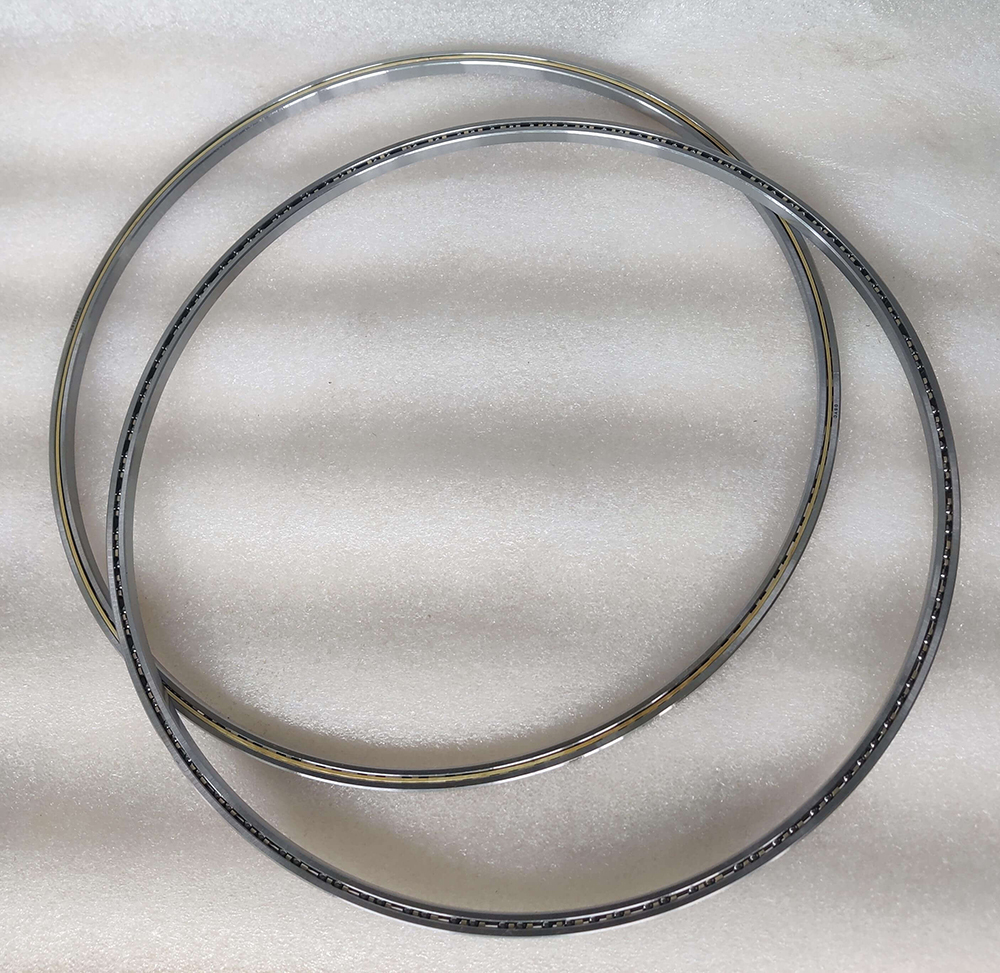
Type A: Angular Contact Bearing
Type A is designed for combined radial and unidirectional axial (thrust) loads, and high-precision applications. It has a 30-degree contact angle, giving it greater unidirectional thrust capacity than Type C or Type X. However, it handles thrust in one direction only and must be used in duplex pairs for bidirectional or reversing loads.
Key characteristics: It accepts radial and single-direction thrust loads. It should never be used alone for moment loads. It is almost always used in back-to-back or face-to-face pairs with preload to increase stiffness. Matched pairs with factory preload are available. Friction is lower than Type X. The outer ring is marked with an arrow and THRUST to indicate load direction.
Best applications: Instrument gimbals, radar systems, machine tool spindles, and any application requiring high stiffness with combined loads.
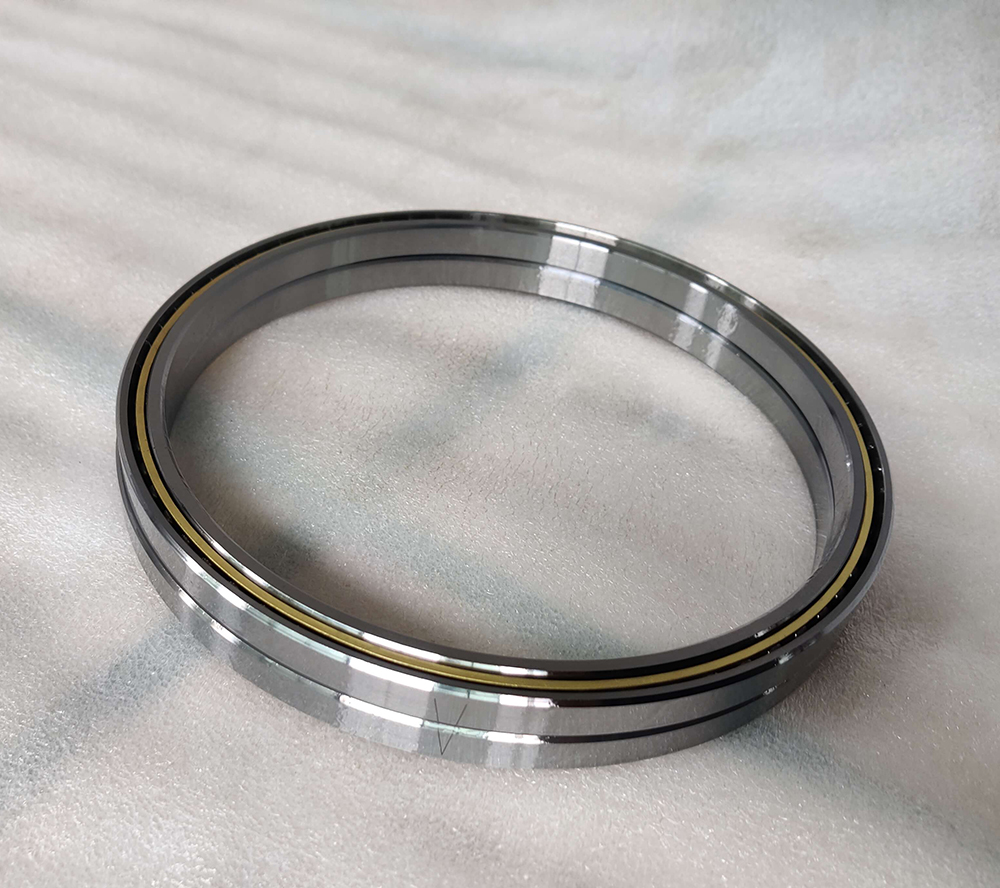
Type X: Four-Point Contact Bearing
Type X is designed for applications where a single bearing must handle radial, axial, and moment loads simultaneously, and space allows only one bearing position. Its Gothic arch raceway creates four contact points around each ball, enabling one bearing to resist all three load types at once.
Key characteristics: It handles moment loading and reversing axial loads well. One Type X can replace two bearings. It can be supplied with internal preload for greater stiffness. It has higher friction than Type C or Type A. It is not recommended for pure radial loads. Two Type X bearings on the same shaft are not recommended.
Best applications: Robotics joints, semiconductor equipment, satellite mechanisms, and compact turntables with significant moment loads.
Selection Quick Guide
Choose Type C for primarily radial loads. Choose Type A in duplex pairs for combined radial and unidirectional axial loads. Choose Type X for combined radial, bidirectional axial, and moment loads in a single bearing position. Choose Type C or Type A duplex for low friction. Choose Type A duplex or Type X for high stiffness.
Application Examples
Industrial robots use Type X for joints requiring moment capacity in tight spaces. Electro-optical imaging systems use duplex Type A pairs for stiffness and lightweight design. Medical and dental equipment, such as surgical robotics and precision imaging devices, commonly use Type A duplex pairs where high precision and reliable positioning are essential . Semiconductor manufacturing equipment also relies on Type A bearings for inspection and wafer handling systems that demand accuracy and low friction in compact spaces.
Choosing the right thin-section bearing is the first step toward optimizing performance and reliability in compact designs. Shandong DSYC Bearing Co., LTD offers a full range of Type C, Type A, and Type X bearings, backed by expert technical support to help you make the right choice for your application. Trust DSYC for precision, quality, and lasting value.